The Mobile Foraging Companion
Now FREE!!
The Mobile Foraging Companion is a feature-laden, cross-platform guide for common wild and naturalised edible plants of temperate North America, and Britain and Northern Europe (there is a guide for each of those two areas, to suit your needs).
Whether you forage on a leisurely weekend walk, want to know about that weed in the garden, or want to prepare for a potential survival situation, this guide is one of the handiest reference guides on foraging. It is designed for quick access to all the essential information you want at your fingertips, no more wading through long text to find the facts you are looking for.
This unique guide packs a lot of information into a small space:
- list of over 300 plants with basic information on edible parts (with icons and colour coding for quick reference), how to consume, and caution notes
- detailed profiles of about 50 plants with guide to identification, culinary, medicinal and other uses - most are illustrated
- month by month list to availability of those plants featured in detail
- stay safe with caution notes including warning features to look out for
- a small herbal section with examples of wild plants, which may be used for home treatment or first aid in the wild
- glossary of medicinal terms
- general information on plant parts, collecting and preparation, including a way to extract protein from grass and other leaves (indispensable for extreme survival situations)
- key to colour coding and other information for quick reference
- find plants by English or botanical name
What is the difference between the N. American and the UK version?
There isn't a lot of difference, as most of the plants included grow throughout most of the temperate northern hemisphere.
Common names of plants vary, so each guide is written with the appropriate names for those countries. The American guide has distribution maps, as distribution of plants can differ widely on such a large continent.
What format is the guide?
It is cross-platform. How? It is written with webpage code - html. It is like a mini website. You can view it online or download a zip file. The zip file is wrapped up for off-line viewing (no need for an internet connection once you have downloaded the guide).
Web-technology is very flexible. You can put it on many different devices - mobile or desktop, and many different platforms - iOs, Android, Windows, Mac and more, and any size. You can use the downloadable version on any device which has some file management ability and can read web pages. The code is lean and makes for a lighter app. It also allows for a very pretty "app"  .
.
There is a small price to pay for this flexibility. There is no home screen icon or accelerated scrolling, and, as mentioned above, you need software which can import files and view web pages.
However, you may already have the software on your device, and if not, I can recommend a few apps which may work for you. I have also provided a demo which you can download to test on your device, and one you can view right in your browser.
More technical information, help and tips on use here .
Online version
If you have an internet connection you can view the guide online in any browser. Just bookmark one of the links below for the start page.
Temperate N. America start page
UK and temperate Europe start page
Downloadable version
If you want to use the guide off-line, you need to download it. Check compatibility and downloading ability with this zipped test file.
More technical information, help and tips on use here .
Please note that the test file is slightly different to the current version. There are some minor changes in navigation and the "Parts" page now has drop-down access to the various plant parts instead of links to separate pages. This free version also has an advertising page at the start - please see below.
Advertising
This version does not cost any money, but the price is that it contains adverts. However, I will only advertise products which I feel have either no net damaging environmental impact or those which may even save resources directly or indirectly by aiding efficiency and self-reliance. And, hopefully, you will find some useful ones.
There is also a printable PDF available for both regions.
Screenshots
Click thumbnails to enlarge, click or focus popup to close
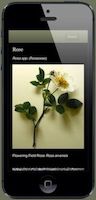
Image page from Rose plant profile
Rose profile page
List of over 300 plants with basic information
Share this Guide
You may share this guide as long as you do not change it or charge for it.
Download
Before you download, please read the format information above and download the test file to see if it works on your device. If you have read the above you can click/tap the "Instruction" button below for more information:
InstructionsDownload the Foraging Companion for Temperate North America:
Download TNADownload the Foraging Companion for Temperate Europe:
Download TEuDisclaimer
The information in the guide is given in good faith, but is not complete. Consumption of plants is at the reader's own risk and discretion.
Some guidance may reduce the risk of starvation in a survival situation, but it is best to err on the safe side when other food is available.
The photographs in the guide are intended as a guide only, and should not be relied upon for identification, which should always be done with a good field guide.
What happened to the printable version?
The pocket-sized version has been discontinued as a mobile app is more convenient to carry. For those who want a printable version for times when technology fails, there is a new, larger guide. For more details see this page.