Judy of the Woods
productivity, creativity, sustainability - self-reliant living in the 21st century
Wild Food Handbook
print your own handy pocket foraging companion and hedgerow herbal,
or get the
FREEplant list with details on edibility of over 350 plants.
The new Handy Foraging Companion and Hedgerow Herbal is now available for download. If you were put off by the
printing process of the Wild Cardsguide, you will be pleased with the new version, which can
be printed on paper, and single-sided, if you prefer. For a test run or a sample of the content please check out the
guide page.
Warning - this post contains graphic descriptions of medical procedures. Not for the squeamish.
Doctor knows best. Well, not always. So this grizzly little tale took place a few decades ago, and some of these practices are thankfully
something you will only read about in medical history books (or blog posts), but people are still mutilated, irradiated and poisoned even today,
and some of it may not be necessary.
The tale I have to tell is one that happened to me back in 1968, and is one of a bazooka being used to kill a mosquito, and how a simple weed
could have saved me all the agony back then, and the worry I have carried for the best part of forty years.
This guy is a wizard on the harmonica. His band Shuffletones is also very talented, and I think they deserve a brake. If you like blues and quality independent music and have a website, grab the code. You can listen to a few tunes of Shuffletones on their Myspace page . Warning though, the volume on the page is very high, you may want to turn it down on your computer first. Its as good as anything that came out of the 70s, and I mean the best.
Holographic Conference
February 7th, 2008
A bit gimmicky perhaps - a normal projection would have served the same purpose, but still better than the 2,788kgs of carbon dioxide supposedly used had he flown,
and all the other environmental and social problems caused by the flight. Found via
post on transitionculture.org.
Not one to shy away from this prickly subject, Graham Strouts of zone5.org has just written an excellent critique on Monbiot on Population. He clearly argues that the
population issue is not one of consumerism - v - large numbers of poor people, but shows how intricately the two are entwined, and
that it is a whole earth problem caused by the Total Human Footprint. Would seem obvious to some, but there are plenty who argue
that there is a distinction. Here is an excerpt of his post:
"But it is not simply that there are rich people in the world and then there are poor people; it is more that there are rich people because there are poor people- the one group depends in effect on the other (the poor do low-paid work for the rich). In a sense, the “poor” are simply “that group of people that have failed as yet to become rich”. The rich and the poor of the world are not separate species; wealth is not genetic. It is a one-world system in which the activities of one group effect the activities of the other- and of both groups, the impact on the whole system."
Appologies to my subscribers - the link in the RSS feed should have been on "excellent critique" and not "Monbiot on Population". Here is the link to the original Monbiot article
If you like candles, live without electricity, or like to have some lighting back-up, you might like this simple little DIY project. An oil lamp can have a number of advantages over candles and mineral oil lamps:
very cheap to run - can even burn used cooking oil
the fumes are less toxic than those of paraffin candles or mineral oil lamps
the production of renewable vegetable oil is less harmful to the environment than petroleum based products (including paraffin candles)
for the extreme survivalist, vegetable oil is easier to store in bulk, or can even be produced on the home farm
due to the wider base, more stable than candles, and the flame of any burning wick falling into the oil will be extinguished
odour free when using olive oil
Making an oil lamp is very easy, quick and cheap, and gives plenty of opportunity for a creative outlet. The basic element is nothing more
than a piece of twisted wire, a length of twine, some vegetable oil and a vessel to hold it all in. The photos pretty well show how to do it, but there are
a few tips which might help, and save some trials and errors.
If you have a plain html website which is periodically updated, you don't have to miss out on some of the great features of blog engine run proper blogs. Comments and RSS are two of the most obvious and useful features of blogs. At a glance, my site may appear to be a proper blog, but it is a very simple, hand crafted website, with a few third party widgets (check out the page source). The new comment feature is cut and past java script, which is very easy to install, and is run on the supplier's server. The basic code is just two very short lines, one being the link. It is quite basic, but does allow some customization, and above all, it allows communication with your readers. And, if that wasn't enough, it is free. So go and grab yourself the script at JS-Kit.
You can try it out at the end of this post. Just say test, if you like, and no need to delete tests - leave them for others to see how it works. When there is a bunch of them, I will delete them eventually. They have a few other widgets, like rating and polls. If you are worried that JS-Kit may vanish one day, along with all your hard-earned comments, you could copy and paste the comments permanently into your pages, after allowing a set period when visitors can go back to delete their comments if they wish. That is what I intend to do here, after, say, at least a month.
If like me, you have relied on email communication, you may find more visitors responding with comments, as many don't like giving out their email address. With this widget there is no need to register. Oh, and you can even show your face, if you like. Now is that neat, or is it neat?
At last, the long awaited Wild Cards - Handy Foraging companion and Hedgerow Herbal. This downloadable concise, illustrated 88 card pocket guide contains
a list of over 350 plants in a handy format, as well as detailed profiles on over 50 common edible plants.
Use like index cards for home reference ......(click to enlarge)
.....or bind them to use as pocket guide
Whether you forage on a leisurely weekend walk, or want to prepare for a potential survival situation, Wild Cards are your handy companions.
This unique guide packs a lot of information into a small space
list of over 350 plants with basic information on edible parts (colour coded for quick reference), how to consume, and caution notes
an illustrated directory of over 50 plants with guide to identity, culinary, medicinal and other uses
month by month chart to availability of those plants featured in the directory
caution notes including warning features to look out for
glossary of medicinal terms with brief list of relevant plants
general information on plant parts, collecting and preparation
This binding system is so new, you won't have heard of it. The Dirt Cheap Milk Container binding system is, well, dirt cheap,
is made with milk containers, and only came into existence today. As with so many of my tinkering projects, the idea was
born out of necessity. A little while back I became enamored by the
Circa and Rollabind binding system, or it's European
counterpart Atoma and
ADOC . At first I asked the same question I have heard
being asked since - what is it with these discs? The answer was in Douglas Johnston's post
Review: The Levenger Circa System, Part I on the
DIY Planner website. The disc binding system is very versatile. Lets
look at some of the key advantages:
add or remove pages
the book can lie open
360 degree turning
mix and match different sizes of paper in same book
customize to your heart's content with a punch
You can add and remove pages and customize ring binders, and they will lie open flat, however, you can not fold the pages back. This, and the
binding mechanism makes ring binders clunky items. Even if you have a humongous desk (i.e. about 1/10 of a football pitch), the most valuable
space is within arm's length, so every
inch counts. When you get down to about A7 size, the mechanism makes the binder unnecessarily large, and a standard two ring binder will
not accept paper smaller than A7. The one inch spacing on the disc system allows business cards to be punched on the short side. There
are small speciality ring binders sold as planners, which can take smaller paper, but the binder size is usually some custom size, and so is the
hole arrangement, making the purchase of an expensive punch necessary, and the cutting of paper wasteful.
Wire bound (spiral or twin wire) have the advantage of lying flat, and turning 360 degrees, however, you are stuck with the book you bought,
and can not move paper around. A spiral can be threaded in and out, but this is more than tedious. Comb binding is somewhat more flexible, but
does not easily turn back on itself, and has the habit of opening up and even braking. The punch and binding machine is a hefty item.
Then there are treasury tags and screw posts, binder rings and bits of string, staples or glue, all of which have plenty of disadvantages as a
serious flexible binding mechanism for a planner, notebook, project binder, contact book or whatever else you wish to custom make.
With the disc system you can make any size, any type of book you choose, fill it with your own printed templates, blank paper, ruled, unruled, pockets,
fancy paper, anything. There are several sizes of discs to choose from, so you can make a dinky little pocket pad, or a thick year planner with all
your contacts under one cover. But there is a sting in the tail. The disc system requires a special punch, which is not cheap, especially if you live
outside of the US. That is the point at which doubt began to creep in. By the time I had bought the punch and a few packets of discs, I would
not have had too much change from £100. But I liked the idea, and so I began to ponder the DIY route, which, I am pleased to say, has led me to
a binding system with all the above advantages, and one I (and probably most of you) could get started with straight away. It requires few tools and
materials (even recycles materials) to make the binding mechanism, and uses a standard two-hole punch, which can be purchased for as little as £2.
Have you ever looked at a wild plant, and wondered if it was edible? Foraging is very popular these days, but alas, most field
guides on wild plants do not give any information on edibility, and most foraging guides are a cumbersome item to take into the
field as an additional item. They do, of course give information on how to prepare the food, along with interesting historical
snippets, and other useful data, and are still a valuable item to have on the book shelf, especially if you want to take up foraging more seriously.
To lighten your load, I have prepared a list of plants, which will only add a few extra pages to the field guide, but give you that
valuable missing information.
The new revised and expanded UK list has details of over 300 plants, which are considered by some publications
to be edible. The list includes trees, shrubs, coastal and wetland plants. Details include common name, botanical name, family, caution notes,
which part is edible and in what way it may be consumed. Following the plant list is a key, and important information
on safety, as well as some additional information, which must be used in conjunction with the list.
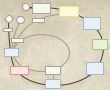
One of the main aids to organizing in the slip method is - you've guessed it, the slip, more specifically the action slip. The little work
docket is transient, passing through the system temporarily. It pauses along its route and is given additional information; the where,
how, when, who and what. Its behavior is ordered but flexible. It carries a unit of information and is a building block. Detailed
description of the process, and how to make or obtain a supply will be found in later chapters. Lets follow it on its journey. It can
start from several places. The blank slip is either loose or padded up and resides in a dispenser, a small pocket case, on the
desk, the fridge, memo board, bedside table - wherever you place a quantity in readiness. It may even be torn or cut
from any handy source of paper. All actions are written in brief on the slip - one action, one slip. Just remembered something that
needs doing? Write it on a slip. Just received a bill? Write 'pay bill (and details like who)' and either file the bill if payment is made
from source, or place in bag/briefcase if paid away (e.g. at bank or merchant). No more cluttered in box. Anything that needs to
be acted on goes on a slip, unless it is a quick job that can be done straight away (see more on that in David Allen's Getting
Things Done, or read introductions to GTD on the web).
If you have a water supply (spring, brook or river) below the point where you need the water, and the source is higher than the lowest part of the property,
then a hydraulic ram pump may be the solution. Hydraulic ram pumps are powered by a portion of the water running through it. If the cost of a commercial
pump puts you off, or the water volume is too little to operate the pump, you can make one to suit your conditions at very little cost. There are two
excellent books published by Intermediate Technology on making your own ram pump. One is "Hydraulic Ram Pumps: A Guide to Ram Pump Water
Supply Systems" by T.D. Jeffrey, T.H. Thomas, A.V. Smith, and P.B. Glover. The other is "A Manual on the Hydraulic Ram for Pumping Water" by S. B. Watt.
I would recommend you get both; they do complement each other. They also explain how to design and build
the whole system. The pumps featured in the books do require welding and threading equipment, and the smallest pump has a 2" diameter body which
requires a fair amount of water to operate. However, the principle also works on a smaller scale, and I have made a pump from standard brass 28 mm
compression fittings, with 28mm, 22 mm and 15 mm pipe (all readily available) and with soldering equipment. Read the rest of this entry >
Following below is a copy of a comment I made on Zachary Nowak's article
Communities, Refuges, and Refuge-Communities on
Transition Culture, a UK Peak Oil blog. As blog comments so easily get lost in the archive vaults to gather dust, I thought of resurrecting what I
believe to be a comment on a very important issue, population. The whole saga started with Rob Hoskin's post
Why the Survivalists Have Got It Wrong in response to Zachary's article
Preparing for the Crash: Nuts and Bolts on Energy Bulletin, another Peak Oil website.
Zachary responded to this rather scathing post, and was then given the opportunity to publish the above article on Transition Culture.
In the original article
Zachary took the "doomer" survivalist view of a post peak world, where survival skills will be needed. Rob's response was to paint a picture of a deranged gun
hording lone survivalist, and that cooperation and "we all pull through or none of us do" were the only alternative. In the heated discussion that
followed, commenters soon fell into the "gloomer" or the "utopian" camp, with the survival orientated gloomers rejecting the lone survivalist image.
Sadly, in my opinion, one of the most important issues was hardly touched on, until Zimba of the
Human Extinction Movement boldly stepped in with the taboo subject population control. I would like to point out though, that complete human
extinction would not be necessary for the good of the rest of all life forms (though not lamentable) but a very heavy reduction certainly is, also for any
humans to have any quality of life. I would also like to point out that I am talking about non-replacement.
Emphasis was added on this page.
Today I met a woman from South Africa, from the most southern part, she said. Now, I live in the northern hemisphere, and one of the thoughts
I subvocalised was 'down the very bottom'. Down the very bottom? Later, thinking about it, I imagined being down there,standing
upright without feeling that I was falling off the earth, looking up at the stars, with nothing but sky above me.
Yet, if I were to imagine my home, Wales, on the map, it would also be above me, even though it would be well below me physically. How would
I feel about standing at the bottom of the world?
It is said that a butterfly flapping its wings can trigger a tornado. A seemingly small action or occurrence can lead through a chain of events to a major response,
possibly in a distant location. In this chaos example the trigger event is harmless
in itself, but causes a catastrophic response. But lets look at a reversed scenario, a negative event - small or major, it doesn't matter, but negative - causing
a benefit, the proverbial silver lining. The greater the benefit, the better. Think of something good in your life, and retrace your steps to some mishap which
was an essential step along the route to arrive at your destination. The good thing may simply be being alive. Stories abound of people missing the train,
only to hear on the news later that the train was derailed, causing many casualties. When they realized they had missed the train, they were probably upset,
but relieved later, not to be among the casualties (albeit, in this example, the relief would be tinged with sadness for the actual casualties). Nevertheless, it is
a silver lining, one less person a potential victim.
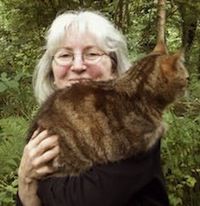
The chain of events which lead to me sharing my life dream with a delightful cat may have started with the Big Bang, and later with the primordial ooze, but in more
recent history, I can trace at least a few mishaps and syncronicities which were essential links in the chain leading to this beneficial outcome.
A blog(ish)? Yeap, not a real, proper, blog engine run blog. Just a simple DIY version pretending to be a blog.
A luddite manual version, with basic html, tables, and email comment. I tried, I really did, to run a
Wordpress
blog, but my coding skills are limited. I may be able to change some obvious text, or insert some script by following instructions, though when it
comes to fixing anything in php or CSS, I am lost. Life is too short to learn all that. Well, maybe in time, but I have content to create.
The website is a means to an end; convey information. I get by reasonably well. Its the 80-20 principle. I get 80% results with only 20% knowledge,
probably even less. Now comes the point of diminishing returns. I am not earning my crust with creating websites, I'm not a web developer.
Anyway, there were other things I did not get on with, so here I am, back at my trusted old website. But I like some aspects of blogs, and I know visitors do too.
New content is up top, you can check it out, or move on. Blogs are interactive. They are the water cooler area, somewhere to hang out and chat, talk shop.
Some of the cool stuff about blogs is something I have not yet figured out how to include (I am investigating
FeedBurner for RSS ), if at all possible, so there are some
short comings. If you want to comment you have to send me an email, though I made it as easy as possible, its just not immediate, and I know some of you don't
like to give out your address, but rest assured, it is safe with me, and unless given in the body of the message because you want it to be public, I do
not publish it. If I can't get RSS to work on this site, the only option is to bookmark it, and check out the updates.
On the bright side, I think a simple website is less code heavy, quicker to download, and I try to make it easy to navigate, and blend as
many of the advantages of each as possible. The overall experience should not be too different to a 'normal' blog, with some of the advantages of a 'static' site.
So cheers, here is to blogg(ish)ing, eh, whatever.
Update
I added a comment widget, so no more need to send an email, unless you want to send me a privat message, and there is no need to register to leave a comment.
You may have also noticed, that I did get RSS to work on here, so not much different to a blog now, at least on the surface.
Webmasters - if you have digital or physical products, e-junkie can handle the download or provides a shopping cart. Also handles affiliates. Easy and cheap. I use it for my foraging guide.
Updates
Find out about the latest additions or changes on this site here.
22 December 2007
I added a new comment widget.
Brief Intro
Empowerment is probably the best word to sum up this site. Ideas, tips, tricks, DIY instructions, and encouragement for
self reliance - without costing the earth. If you read through the pages, you will find that you can do a lot more on a lot less than you may have thought
possible. No need for being rich, strong, a genius, professionally trained, etc. So do dip in, put aside any preconception, and take from this site what you like.
For a more in-depth description please check out the about section, or the site map.
Judy of the Woods
Categories
Thought for the Day
Dance, as though no one is watching.
Love, as though you've never been hurt before,
sing as though no one can hear you,
work as though you don't need the money.
Live as though heaven is on earth.
- Rumi